
American Passages: A Literary Survey
Slavery and Freedom Frederick Douglass (1818-1895)

[6831] Frederick Douglass and Martin Delany, The North Star [banner] (1848), courtesy of the Library of Congress, Serial and Government Publications Division.
In 1839, Douglass bought his first copy of The Liberator, William Lloyd Garrison’s radical abolitionist newspaper. He soon became involved in Garrison’s abolitionist circle and emerged as an eloquent speaker for the cause of African American rights, addressing audiences all over the country with moving accounts of his experiences as a slave. In 1845, he published his Narrative of the Life of Frederick Douglass both to disseminate his story to a wide audience and to quell public doubts about the authenticity of his past as a slave. The book, an outstanding example of the slave narrative genre, was a bestseller both in the United States and abroad, catapulting Douglass to celebrity and making him an international leader in the anti-slavery fight.
Eventually, Douglass broke with Garrison because they disagreed about how best to achieve abolitionist goals. While Garrison disavowed the United States Constitution as a pro-slavery document and advocated only passive resistance, Douglass was becoming increasingly committed to working within electoral politics and to adopting active–and if necessary violent–strategies to ensure emancipation. Douglass moved to Rochester, New York, in 1847 to establish an abolitionist newspaper for the African American population, The North Star (later renamed Frederick Douglass’ Paper). During the Civil War, he worked tirelessly for black rights and was instrumental in convincing Lincoln to enlist African Americans in the Union army. After the war, he held a variety of posts in the government and remained a prominent champion of not only African American rights but also all human rights, including women’s suffrage. He revised his autobiography twice, publishing My Bondage and My Freedom in 1855 and The Life and Times of Frederick Douglass in 1881.
Douglass’s original Narrative was a groundbreaking work of autobiography, setting the standard for many subsequent slave narratives in its eloquent articulation of a man’s achievement of selfhood. Douglass powerfully appropriates the language and conventions of white middle-class American culture to condemn slavery and racism. Drawing on foundational republican ideals of human freedom and equality, he denounces the cruel contradictions and hypocrisies in American culture even as he affirms his hope for its future.
Teaching Tips
- Douglass represents his violent physical encounter with Covey, the “slave breaker,” as a crucial turning point in his journey toward independence and freedom–in his words, it is the moment “a slave was made a man.” Ask students to analyze the importance of this passage. What are the implications of Douglass’s physical assertion of strength and its resulting empowerment? You might ask them to consider how the episode compares to Tom’s passive capitulation to Simon Legree (another “slave breaker”) in Uncle Tom’s Cabin, to Lorenzo Asisara’s account of his participation in an Indian revolt, and to Harriet Jacobs’s account of the very different strategies she used to assert her independence.
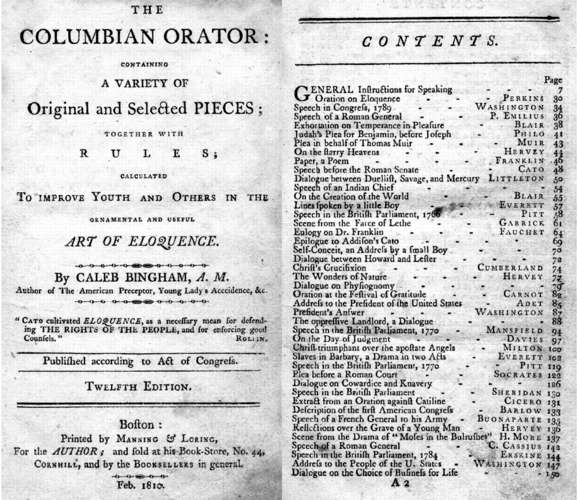
- As the Narrative makes clear, Douglass’s achievement of literacy is a crucial step in his struggle for freedom. One of the texts he uses to learn to read is The Columbian Orator, a compendium of texts chosen for their evocation of American values. First published in 1797, The Columbian Orator was a mainstay of the American schoolroom through the nineteenth century. In it, Douglass would have encountered arguments for natural rights, human freedom, and even for emancipation (in this case, of Catholics). Ask students to consider the role of literacy in the Narrative. They might analyze Sophia Auld’s dramatic shift in attitude toward teaching Douglass to read, Douglass’s covert strategies for teaching himself, and his attempts to instruct other slaves in reading and writing. They might also look at the specific books Douglass mentions reading, such as The Columbian Orator and Cooper’s Last of the Mohicans, to explore how these texts might have influenced Douglass’s values and beliefs.
Author Questions
- Comprehension: Why does Douglass refuse to narrate the details of his escape in his 1845 autobiography? What effect does this gap in information, and the reason Douglass provides for it, have on his narrative?
- Context: Before Douglass’s violent encounter with Covey, he is given a root by his friend, the slave Sandy Jenkins. Sandy claims that the root is a kind of talisman that will protect anyone who carries it. Although Douglass represents himself as skeptical of Sandy’s superstitious belief in the root’s power, he does at some level validate the effectiveness of the talisman in the course of his narrative. What is the significance of this invocation of African American folk magic at this point in the narrative?
- Context: How does Douglass describe Sorrow Songs in his Narrative? How do they affect him personally? What does he believe they signify in slave culture? What does he mean when he says that though they seem “unmeaning jargon,” they are “full of meaning” for the slaves?
- Exploration: Douglass’s autobiographical account of the process through which a “slave was made a man” has often been compared to Benjamin Franklin’s narrative of his own self-making. What do these autobiographies have in common? How do these two writers’ approach to literacy and writing compare? How does Douglass recast Franklin’s ideals to fit the condition of an escaped slave?
Selected Archive Items
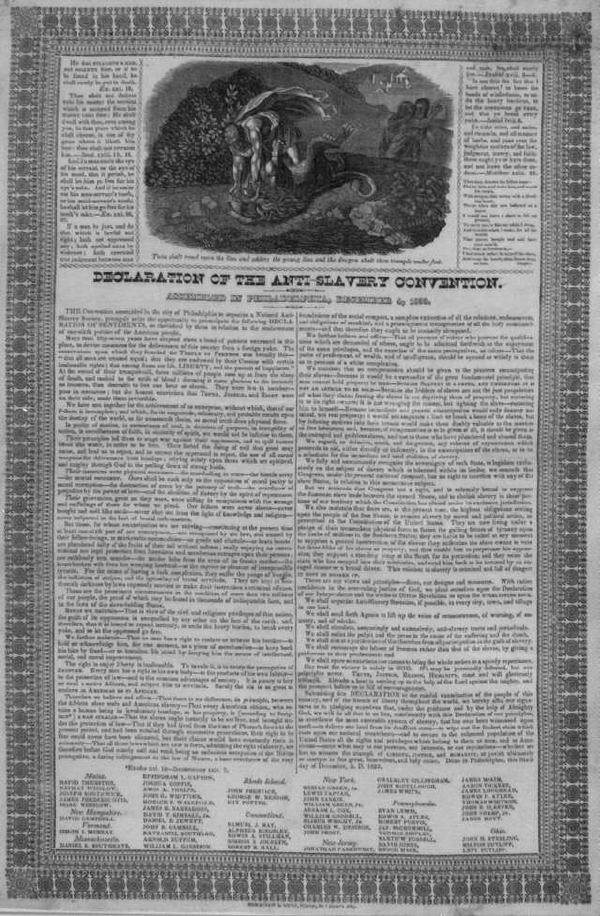
[2534] Reuben Gilbert, Declaration of Anti-Slavery Convention Assembled in Philadelphia, December 4, 1833 (1833),
courtesy of the Library of Congress [Printed Ephemera Collection Portfolio 153, Folder 26].
The woodprint by R. S. Gilbert illustrates Psalm 91.13, “Thou shalt tread upon the lion and adder; the young lion and the dragon shalt thou trample under feet.” Abolitionists used the Bible to emphasize the conflict between slavery and Christianity.
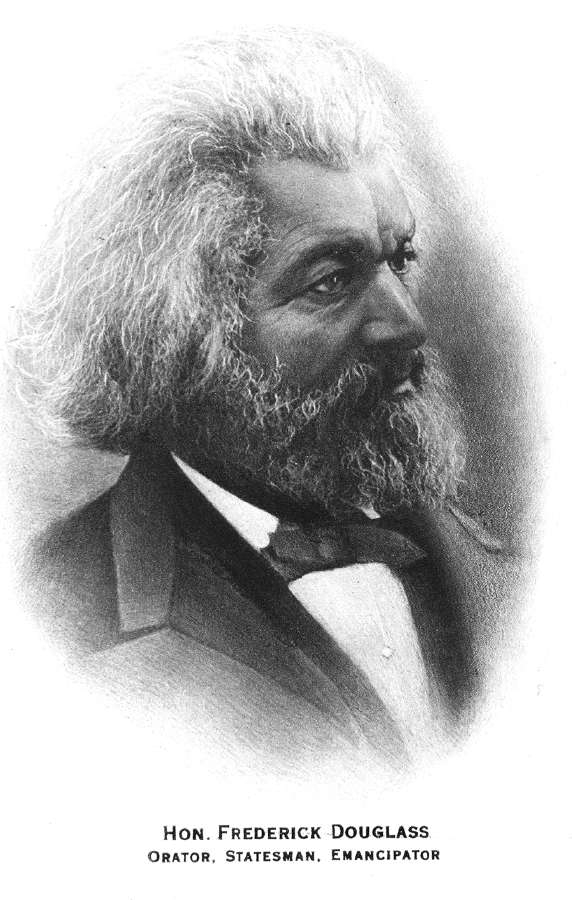
[2729] C. M. Battey, Hon. Frederick Douglass. Orator, Statesman, Emancipator [Photo Postcard] (n.d.),
courtesy of C. M. Battey Photograph Collection, Photograph and Prints Division, Schomburg Center for Research in Black Culture, The New York Public Library, Astor, Lenox and Tilden Foundations.
Photograph depicting Douglass as an elder statesman after the Civil War.
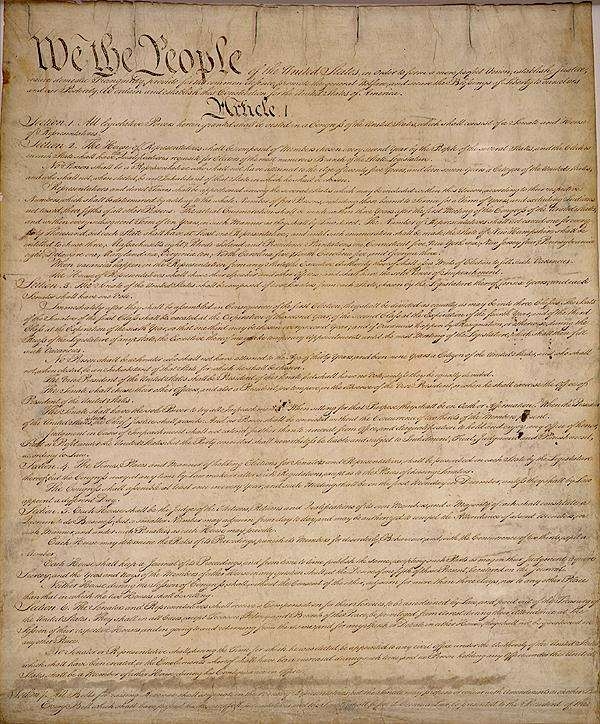
[3292] United States Constitution (1787),
courtesy of the U.S. National Archives & Records Administration.
Delegates met on May 14, 1787, to revise the Articles of Confederation, but instead created a new document, and a new government, one influenced by Greek democracy, the Roman Republic, and Native American (specifically Iroquois) forms of representation.
[3482] William Lloyd Garrison and Isaac Knapp, eds., The Liberator (May 21, 1831),
courtesy of the Library of Congress, Rare Books and Special Collections Division.
The Liberator, launched in 1831, called slavery a crime that should be ended immediately without compensation. Such radical abolitionism became identified with the paper’s editor, William Lloyd Garrison.

[3538] Caleb Bingham, The Columbian Orator… Calculated to Improve Youth and Others in the Ornamental and Useful Art of Eloquence (1811),
courtesy of the University of North Carolina at Chapel Hill Libraries.
Frederick Douglass highlights Bingham’s primer The Columbian Orator in describing his liberation through literacy. “Columbian” implies a distinctly American mode of rhetoric.
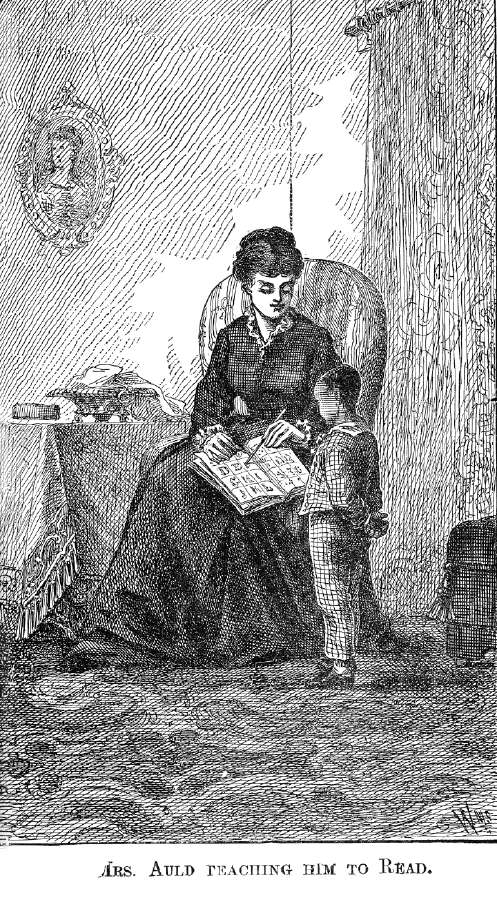
[3570] Anonymous, Mrs. Auld Teaching Him to Read (1892),
courtesy of the University of North Carolina at Chapel Hill Libraries.
This illustration from The Life and Times of Frederick Douglass, Written by Himself, depicts the northern wife of Douglass’s owner introducing Douglass to reading.
[5150] J. Sartain, from a painting by M. C. Torrey, William Lloyd Garrison (n.d.),
courtesy of the National Parks Service, Frederick Douglass National Historical Site.
Garrison helped found the American Anti-Slavery Society, supported immediate emancipation and the Underground Railroad, and sponsored Frederick Douglass.

[6831] Frederick Douglass and Martin Delany, The North Star [banner] (1848),
courtesy of the Library of Congress, Serial and Government Publications Division.
The North Star was an abolitionist newspaper published by prominent black intellectuals Douglass and Delany in Rochester, New York. Its name symbolized a guiding light to freedom; escaping southern slaves used the North Star to find their way to the free states or to Canada.

[7220] Frederick Douglass IV, “Reading from the Narrative: Detesting My Enslavers Through the Power of Learning to Read” (2001),
courtesy of Annenberg Media.
Frederick Douglass IV is the great-great grandson of Frederick Douglass.