
Private: Learning Math: Geometry
Dissections and Proof Part A: Tangrams (15 minutes)
Session 5, Part A
In this part
- Exploring Tangrams
- Moving Tangrams
Exploring Tangrams
A tangram is a seven-piece puzzle made from a square. A typical tangram set contains two large isosceles right triangles, one medium isosceles right triangle, two small isosceles right triangles, a square, and a parallelogram.

Use a set of tangrams, or print and cut out the set provided here, to work on the following problems.
 Think about the angles you need to create in order for a shape to be a square.
Problem A1
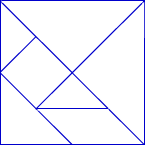
Given that the tangram puzzle is made from a square, can you recreate the square using all seven pieces?
Problem A2
Use all seven tangram pieces to make a rectangle that is not a square.
Part A (continued): Moving Tangrams
One set of tangram pieces can make more than one shape. Geometric language helps you give clear descriptions of how to move pieces to change one shape into another. Roll your cursor over each of the three images below to see an animation of that move.
Slide or Translation
Here, a parallelogram made of two small triangles becomes a square as you slide one of the small triangles parallel to the base of the parallelogram. This type of movement is known as a translation. Try this with your tangram pieces.

Flip or Reflection
Here, the parallelogram becomes a triangle when you flip one of its halves (small triangles) at its horizontal midline. This type of movement is called a reflection. Try it.

Rotation
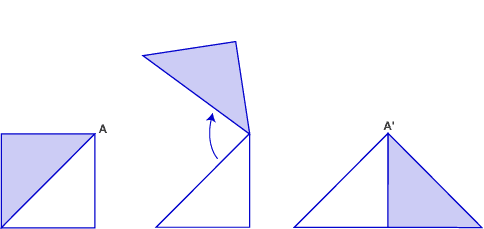
Here, a square becomes a triangle when you rotate one of its two halves (small triangles) 270° around vertex A. This type of movement is called a rotation. Try it.
Problem A3
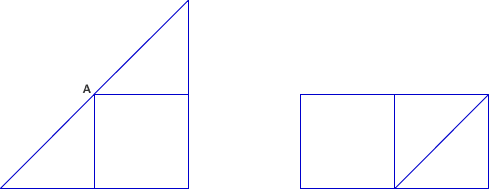
For each of the pairs of figures below, do the following:
- Build the shape on the left with your tangram set.
- Turn it into the shape on the right by reflecting, rotating, or translating one of two of the pieces. (This may take more than one step.)
- Write a description, telling which piece or pieces you moved and how you moved them.
a. 
b. c. |

Problem A3 adapted from Connected Geometry, developed by Educational Development Center, Inc. pp. 162-163. © 2000 Glencoe/McGraw-Hill. Used with permission. www.glencoe.com/sec/math
Solutions
Problem A1
Problem A2
Here is one possible solution:

Problem A3
|
|||||||