
Inside Writing Communities, Grades 3-5
Building a Community of Writers
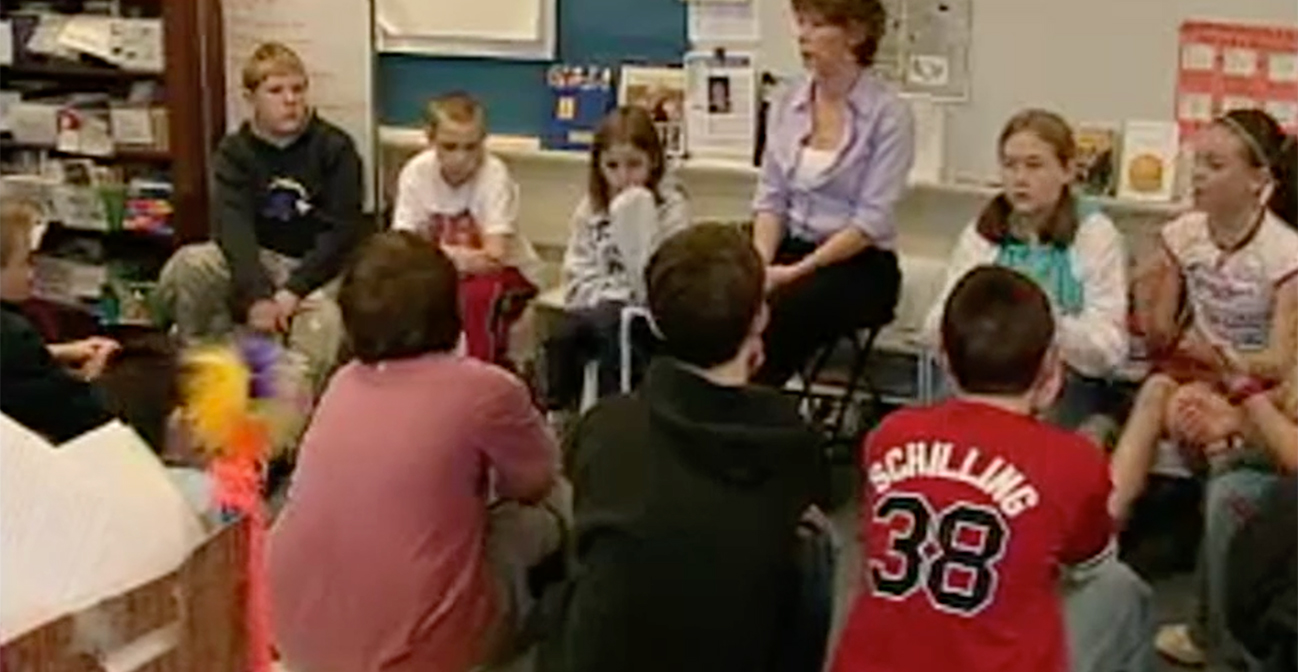
How can you nurture and support the confidence of all students and help them forge unique writing identities? This workshop explores the essential characteristics of a successful writing community and shows examples of teachers who build community in their classrooms through a variety of ways.
I think it’s amazing what kids can do at this age if we give them the chance. As teachers, we have to cherish the joy children get from writing because what matters most in our teaching is that we not only help students become better writers, we also help them to want to write, to love what they’ve created in words.
— Jack Wilde, retired teacher and author of A Door Opens: Writing in Fifth Grade
Learning Goals
In this workshop you will explore how to:
- nurture a structured classroom writing community that fosters trust among students
- establish shared values about good writing, the work that writers do, and respect for others’ work
- participate as a member of the writing community by sharing your writing
Prepare for the Workshop
To prepare for this workshop, you will review the strategies you already use and read two articles about establishing and building classroom writing communities.

What Do You Do?
Writing communities are built around a set of shared values about writing and the work that writers do. Writing communities must also develop a set of shared values about how the community works. Think about your values and opinions about communities and writing. Answer the following questions in your notebook. Then reflect on your answers in terms of your own practice in teaching writing.
- What are the characteristics of a successful community?
- Describe the characteristics of the communities you currently belong to.
- What are some of the structures, rituals, and routines that are present in successful writing communities?
- What is good writing?
- What do writers do?
- Do you think it is necessary for teachers to be good writers? Why or why not?
- Do you currently share your writing with your students? Why or why not?
- How do you think it can help your students to see you struggle with and solve your own problems as a writer?

Examine the Literature
Print out the Examine the Literature Response Chart (PDF). Then read the article listed below, recording your ideas on the chart during and after reading. When you have finished, save your chart to submit as an assignment.
About Writing: A Letter to Stacie (PDF)
This article illustrates how using a letter format and the tender tone of a grandmother can provide a “big picture” look at a good writing workshop.
Dressel, Janice Hartwick. “About Writing: A Letter to Stacie.” Language Arts (National Council of Teachers of English) 82, no. 2 (November 2004): 95-99. Copyright 2004 by the National Council of Teachers of English (www.ncte.org). Used with permission.
Children Can Write Authentically If We Help Them (PDF)
This article explores how to help students connect writing choices with personal challenges and issues.
Graves, Donald. “Children Can Write Authentically If We Help Them.” Primary Voices K-6 (National Council of Teachers of English) 1, no. 1 (August 1993): 3-6. Copyright 1993 by the National Council of Teachers of English (www.ncte.org). Used with permission.
Analyze the Videos
Key Practices To Observe
“Building a Community of Writers” and “Teacher as Writer” explore how to establish successful classroom writing communities. They feature commentary from experts on teaching writing at the elementary level as well as classroom illustrations highlighting the practices of several teachers.
As you watch, look for the following key practices:
- Teachers model respect for writing and writers.
- Teachers schedule adequate time for writing and writing instruction.
- Teachers provide multiple opportunities for community members to talk about their lives and their writing.
- Teachers and students assist each other with writing.
- Teachers design spaces, rituals, and routines to help nurture productivity and collegiality in the classroom writing community.
- Writers share their work and celebrate one another’s writing successes.
- Teachers are active members of the community, writing alongside their students and sharing and taking risks with their own writing.
Extend Your Learning
Examine Your Practice
Many teachers are reluctant to write alongside their students or to share pieces they have written because they don’t consider themselves strong writers. Read the following quote, consider your own students, and answer the questions that follow.
A teacher who doesn’t feel comfortable with writing can be one of the best mentors for children. If you don’t feel comfortable, just be honest. Teachers don’t need to write so that kids see how to write well; that’s what they’ll learn from their reading. Teachers need to write so that children can see someone else going through the process and so that teachers will understand that process. If writing is hard for you, it puts you in a better position as a teacher because you understand what your students may be feeling.
— Katie Wood Ray
Guiding Questions
Reflect on the quote from Katie Wood Ray and consider your own students. Then write your answers to the questions below in your notebook. If you are working in a group, share your responses.
- Is it necessary for a teacher of writing to be a “great” writer? Why or why not?
- How can it help students to see you struggle with and solve your own problems as a writer?
- How comfortable are you with sharing your own writing with your students? With others, in general?
Try an Activity
 (Disabled due to Flash content)
Personal Reading and Writing Inventory
In this interactive, you will evaluate your own experience and attitude toward writing. The questions will guide you in an inventory of your reading and writing preferences and offer ways for you to add more writing to your life, in and outside of school.
Put It Into Practice
The videos, activities, and readings in this workshop illustrate how predictable routines and rituals in a writing workshop foster feelings of safety and community. Now apply what you have learned to develop rituals that you can use in your practice.
New Rituals for Your Classroom
Use the readings, activities, and video examples in this workshop to brainstorm three daily writing workshop rituals or routines that can help your students generate ideas for writing topics or feel more confident about sharing their writing. Be sure to include the following:
- name of each ritual
- goals and benefits of using this ritual in the writing workshop
- any challenges you may face in implementing each ritual and how might you respond
- expected outcomes of each ritual
When you have finished, save your written work to submit as an assignment.
Reflect on Your Learning
What Did You Learn?
Summarize what you have learned about building a community of writers from the experts’ statements, classroom examples, and the readings and activities in this workshop. Use the questions below to guide your thinking. When you have finished, save your written summary to submit as an assignment.
- Which classroom practices from the videos reflect what you currently do?
- Which practices or ideas are new to you?
- What changes do you plan to make?
- What support and/or resources will you need to implement these ideas?
Related Resources
Web Resources
The Balanced Literacy Classroom (PDF)
This site offers a description of a balanced literacy classroom.
National Council of Teachers of English
NCTE provides research, teaching resources, and articles for teaching writing at all levels.
National Writing Project
This site has a wealth of professional development resources for teachers of writing at all levels.
Scholastic
This site provides resources for teachers, specific to grade level and subject area, including information on and by authors published by Scholastic.
SmartWriters.com
This site features interviews with children’s writers, writing contest links for young writers, classroom resources for teachers and librarians, and a directory of children’s authors and illustrators who are available for school visits.
WritingFix
Sponsored in part by the National Writing Project, the site features interactive writing activities to engage all types of learners.

Print Resources
Atwell, Nancie, and Thomas Newkirk, eds. Understanding Writing: Ways of Observing, Learning, and Teaching, K-8. Portsmouth, NH: Heinemann, 1987. ISBN: 0435084410
This anthology of teachers’ essays about observing the growth of young writers also includes student writing samples.
Davis, Judy, and Sharon E. Hill. The No-Nonsense Guide to Teaching Writing: Strategies, Structure, and Solutions. Portsmouth, NH: Heinemann, 2003. ISBN: 0325005214
The authors use specific how-to details to describe the organization of a successful yearlong writing workshop.
Freeman, Marcia S. Building a Writing Community: A Practical Guide. Rev. ed. Gainesville, FL: Maupin House, 2003. ISBN: 0929895134
This easy-to-use, comprehensive guide focuses on setting up an effective writing workshop for young writers in grades K-6.
Harste, Jerome, Kathy Short, and Carolyn Burke. Creating Classrooms for Authors and Inquirers. 2d ed. Portsmouth, NH: Heinemann, 1996.ISBN: 0435088505
This book explores how to set up supportive classrooms in which children become real readers, writers, and inquirers.
Hindley, Joanne. In the Company of Children. Portland, ME: Stenhouse Publishers, 1996.ISBN: 1571100105
The author offers a practical, useful examination of her own experience teaching a reading/writing workshop in her third-grade classroom.
Morgan, Bruce, and Deb Odom. Writing Through the Tween Years: Supporting Writers, Grades 3-6. Portland, ME: Stenhouse Publishers, 2004. ISBN: 1571104062
A case study explores how the authors (both teachers at the same school) returned to their roots as writing workshop teachers and re-inspired their students to write.
Ray, Katie Wood. What You Know by Heart: How to Develop Curriculum for Your Writing Workshop. Portsmouth, NH: Heinemann, 2002. ISBN: 0325003645
This book demonstrates how teachers can use their own experiences reading and writing to shape their writing curriculum.
Profiles
Literacy Experts
 Ralph Córdova, Ph.D.
An assistant professor of education at Southern Illinois University, Edwardsville, Ralph has been a Spanish/English bilingual teacher since 1992. He has been a member of the National Writing Project for 11 years and serves on the Elementary Steering Committee of the National Council of Teachers of English. Ralph co-directs the educational program for the Austin Val Verde Foundation as it intersects with CICERO Learning network, a national Finnish educational initiative, of which his Cultural Landscapes Teaching and Learning Collaboratory is a part.
 Isoke Titilayo Nia
An educator for more than 25 years, Isoke also spent 13 years as Director of Research and Development at the Reading/Writing Project, Teachers College, Columbia University. She currently travels throughout the U.S. and abroad as a literacy consultant through All Write Literacy Consultants, an organization she founded in 2001. She writes short stories and is at work on a book on the study of genre in the process classroom.
 Katie Wood Ray, Ph.D.
Katie is a full-time writer and researcher on the teaching of writing. With a particular focus on the study of writing craft, she leads teacher workshops and summer institutes across the nation related to the teaching of writing. Her professional background includes both elementary and middle school teaching experience; eight years as an Associate Professor of language arts education at Western Carolina University; and two years as a staff developer at The Reading and Writing Project, Teachers College, Columbia University. Katie is also the author or co-author of numerous articles in professional publications and five books on the teaching of writing, including Wondrous Words: Writers and Writing in the Elementary Classroom(1999, NCTE) and The Writing Workshop: Working Through the Hard Parts (And They’re All Hard Parts) (2001, NCTE).
 Karen Smith, Ph.D.
Karen is currently an associate professor in the education department of Arizona State University. She spent 20 years as a teacher in a multilingual, combined fifth- and sixth-grade classroom. Prior to her position at ASU, she served as Associate Executive Director at the National Council of Teachers of English. She has written numerous articles and a book chapter, “Enhancing the Literature Experience Through Deep Discussions of Character,” from What a Character, published by the International Reading Association.
Featured Teachers
 Jeanne Boiarsky, Ph.D.
Third-Grade Teacher
Zaharis Elementary, Mesa, Arizona
Jeanne is currently in her 16th year as a teacher. In addition to third grade, Jeanne also has taught at the first- and second-grade levels. Dr. Boiarsky received her bachelor’s and master’s degrees in elementary education from Arizona State University, graduating cum laude. She received her Ph.D. in elementary education from Lacrosse University in Mississippi.
About the School:
Located in the suburbs of Phoenix, Zaharis Elementary’s student population of 780 is predominantly Caucasian (83 percent). Virtually everyone at the school — students, teachers, administrators, and support staff — keeps a writer’s notebook.
 Lindsay Dibert
Fifth-Grade Teacher
Danville Elementary, Danville, New Hampshire
Lindsay Dibert has been teaching fifth grade for the past six years. She has served on technology and distance learning teams for the Timberlane Regional School District. Lindsay earned her bachelor’s degree in elementary education from Bowling Green State University in Ohio and her M.S.T.E. from the University of New Hampshire.
About the School:
Danville is a small town in southern New Hampshire, and Danville Elementary is one of five elementary schools in the Timberlane Regional school district. The school enrollment is nearly 400, and 96 percent are Caucasian.
 Silvia Edgerton
Fifth-Grade Teacher
Herrera School for the Fine Arts, Phoenix, Arizona
A 22-year teaching veteran, Silvia Edgerton has worked with students ranging in age from 6 to 14. She received her bachelor’s degree from Arizona State University. A second language learner herself, Silvia leads reading and writing workshops for parents of Herrera School students.
About the School:
Located in the urban core of Phoenix and among the poorest districts in the nation, Herrera is a fine arts magnet school with a comprehensive arts curriculum. Predominantly Hispanic (93 percent), 44 percent of the students are second language learners. The school has a two-way bilingual immersion program in which non-Spanish-speaking students are learning Spanish and native Spanish speakers are learning English.
 Mark Hansen
Third-Grade Teacher
Clarendon Elementary, Portland, Oregon
Mark Hansen graduated from Swarthmore College with degrees in anthropology and sociology. His first experience in teaching was as an assistant working with fourth- and fifth-graders with severe emotional problems. He went on to teach adjudicated teenagers in a Los Angeles mental health facility before returning to college and graduating from Lewis and Clark College’s MAT program in 2001. He has been teaching third grade for four years at Clarendon, where he is also the Title One Coordinator. He serves on the steering committee of Portland Area Rethinking Schools, and published an article in Re-thinking Education On-Line.
About the School:
Clarendon’s student population of 338 represents a wide diversity of ethnic groups — almost 50 percent of students speak a language other than English in their homes, and bi-weekly parent meetings are held in English, Spanish, and Hmong. No walls separate classrooms, and teachers are encouraged to mix students of different ages for a variety of activities.
 Nicole Outsen
Fifth-Grade Teacher
North Hampton School, North Hampton, New Hampshire
Nicole Outsen has been teaching at the elementary level since 1996. She began her teaching career in New York City, and has been teaching at North Hampton School since 2001. Nicole presents workshops on reading and writing for the University of New Hampshire Department of Continuing Education and is the author of Teaching Comprehension Strategies All Readers Need: Mini-Lessons That Introduce, Extend, and Deepen Reading Skills and Promote a Lifelong Love of Literature (Scholastic, 2002). She received her bachelor’s degree in English from Barnard College, Columbia University. She earned her master’s degree in Teacher Leadership from the University of New Hampshire.
About the School:
Located in a small town with a population under 5,000, North Hampton School serves 481 students in preschool through the eighth grade. The school received a Blue Ribbon Award from the No Child Left Behind Blue Ribbon Schools. North Hampton emphasizes world languages, multiple assessment tools, individualization, and service learning. The majority of the students (97 percent) are Caucasian.
 Latosha Rowley
Third-Grade Teacher
Cold Spring Academy, Indianapolis, Indiana
Latosha Rowley has been teaching for six years in grades 2-5. She serves in her school district’s leadership program, and co-wrote an article published in the NCTE publication Primary Voices, titled “Making Meaning.” She received her degrees from Indiana University and currently attends Ball State University in Muncie, Indiana.
About the School:
More than 300 students attend Cold Spring Academy, a K-8 program with a focus on environmental studies and stewardship as well as on commitment to community action. Nearly 90 percent of the students are African American.
 Christine Sanchez
Third-Grade Teacher
Tohaali Community School, Toadlena, New Mexico
Christine Sanchez has been teaching for 11 years, two years at Tohaali Community School on the Navajo reservation. Christine is also Navajo and, like her students, grew up on the reservation near Crownpoint, New Mexico. Christine received her bachelor’s degree in humanities from Fort Lewis College and her master’s in educational leadership at Western New Mexico University.
About the School:
Tohaali is both a day school and a boarding school — many of its 200 students live in dormitories during the school year. All students at Tohaali Community School are Navajo. The school serves kindergarten through eighth grade, with about two-thirds of students eligible for free or reduced lunch.