
Engaging with Literature: A Video Library, Grades 3-5
Sharing the Text
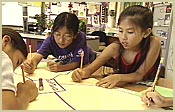
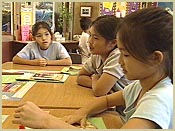
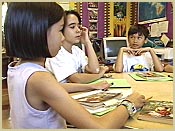
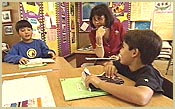
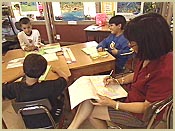
BJ Namba's third-grade class works in book groups to connect with characters and perspectives offered by texts that portray unfamiliar situations. Ms. Namba interacts with the groups, demonstrating when to step in to the conversation and when to stand back and observe the group's work. Texts include The Pinballs by Betsy Byars, Just Juice by Karen Hesse, The Great Gilly Hopkins by Katherine Paterson, War With Grandpa by Robert Kimmel Smith, and Maniac Magee by Jerry Spinelli.
 “Discussion is really important to the students because they learn from each other…They may be confused about something, and they may not admit it, or they may not even be aware that they were confused or didn’t understand something. But…the discussion really enables them to clarify things that they’ve read.”
BJ Namba, 3rd-Grade Teacher
Punahou School
Honolulu, Hawaii
Ms. Namba understands that her students are lifelong envisionment builders, and her goal during the year is to help them become increasingly independent. By year’s end, she wants them to be completely responsible for their own literature discussions without needing her facilitation. Throughout the year, Ms. Namba uses a variety of “engagements” — activities that encourage conversation and focus on learning to use the literature to make personal connections and appreciate perspectives — either those presented in a text or by classmates — other than their own.
About This Video
Ms. Namba believes in the power of what her students learn from the literature discussions in their book clubs — a sense of responsibility, ways to make meaning from texts and information, connections to themselves, their worlds, and other texts, appreciation and respect for multiple points of view, and cooperation. These, she believes, are lifelong lessons.
In this video, you will see Ms. Namba and her third graders working together in literature book clubs centered on five different novels. In this case, Ms. Namba has chosen a number of books that focus on characters and issues quite different from those this group of students is likely to encounter in their own lives.
As you watch, note the ways in which the students assume key roles in the discussion. Ms. Namba’s questions typically ask for clarification or development of student-developed lines of thought rather than directing the discussion. Clearly, such discussions are the result of a great deal of previous training. In addition, these discussions take time as students work to develop their understandings of the literature and as well as their skillful use of book club time. Ms. Namba feels that this time is well spent because of the quality of student learning it allows.
For resources that can help you use this clip for teacher professional development, preservice education, administrative and English/language arts content meetings, parent conferences, and back-to-school events, visit our Support Materials page. There you will find PDF files of our library guide, classroom lesson plan, student activity sheets, and other Teacher Tools.
Featured Texts
The Pinballs by Betsy Byars
The “Pinballs” are three unwanted foster children — Carlie, Harvey, and Thomas J.-who have been abused, abandoned, and bounced around. Carlie trusts no one, believing that as soon as she gets settled, somebody puts a coin in the machine, and she will find herself bouncing from bumper to bumper again. With the support of their foster parents, the Masons, the three children become friends, learn to care for each other, and begin to experience love and trust.
Just Juice by Karen Hesse
School lessons are a mystery to nine-year-old Juice who simply cannot manage to understand numbers, letters, and reading although she likes to explore and learn and has a talent as an apprentice metalworker in her Pa’s makeshift shop. In spite of her family’s persuasions, Juice avoids school as often as possible, choosing instead to work with her father, who has been laid off from his work at the mine. Pa keeps it a secret that he can’t read either, and because he can’t deal with the official papers regarding past-due taxes, the family could lose their house. When her diabetic mother gives birth, Juice is the only one home. She forces herself to read the sugar monitor, does so properly, and saves her mother’s life.
The Great Gilly Hopkins by Katherine Paterson
Gilly Hopkins has been in more foster homes than she can remember and yearns to be back with her mother. She has been unsuccessful in each foster home and has developed a county-wide reputation for being brash, rude, and completely unmanageable — although brilliant. When she is sent to live with the Trotters, she finds them the strangest family she has lived with yet and she devises an elaborate scheme to get her real mother to rescue her. The rescue doesn’t work the way she has planned, and when it is time for her to leave the Trotters, she thinks about doing so with regret.
War With Grandpa by Robert Kimmel Smith
Peter Stokes is 10 years old when his newly widowed grandfather comes to live with the family. At first he is delighted, because he loves his grandfather, but then he learns that his grandfather will be moving into his own room — the room Peter has had all his life. Spurred on by the urging of his two friends, Peter declares war on his grandfather in an effort to get his room back. After he plays a number of mean tricks on his grandfather, he finally does get his room back — but with his grandfather’s help.
Maniac Magee by Jerry Spinelli
Jeffrey Magee’s parents are killed in a trolley accident when he is three, and he is sent to live with his Aunt Dot and Uncle Dan. His aunt and uncle won’t speak to one another, using Jeffrey as their go-between. After eight years, Jeffrey has had enough. He screams, “Talk to each other!” and runs away — literally. He runs, searching for a real home, eventually ending up 200 miles away in the town of Two Mills, a community divided by race into an East and a West End. Jeffrey becomes “Maniac Magee,” a legend in the town — a boy who can outrun dogs, hit a home run off the best pitcher in the neighborhood, and untie the knot no one else can undo. In his search for a place to belong, he begins to unite the town by forcing at least some of the Blacks and Whites to know each other.
You can access additional resources related to this video clip’s text in the Additional Resources section.
Classroom Snapshot
 School: Punahou School
Location: Honolulu, Hawai`i
No. of Students in School: 3,700 in grades K-12
Teacher: BJ Namba
No. of Years Teaching: 20
Grade: 3rd Grade
Subject: Language Arts
No. of Students in the Classroom: 25
Located in Honolulu, Punahou School is the largest independent school in the United States. Its 3,700 students in grades K-12 reflect Hawai`i’s ethnic, cultural, and socio-economic diversity. Founded in 1841 by Congregational missionaries, Punahou is nonsectarian but retains its Christian heritage. The 76-acre campus includes nearly 30 school buildings and numerous playing fields.
Punahou School is divided into a Junior School (grades K through 8) and an Academy (grades 9 through 12). The Junior School is composed of four smaller, self-contained sections, each designed to meet the special needs of the different ages of the children it serves. An outdoor education program offers nature study and camp experiences throughout the Junior School.
Throughout the Junior School, but especially in the third grade, students study Hawaiian language, history, and culture. They plan and prepare a traditional luau, including roasting a pig in a rock lined pit called an imu. They learn Hawaiian songs and hulas. Ms. Namba and her students begin the school day with a chant asking for learning and knowledge.
Classroom Lesson Plan
 Book Clubs
BJ Namba’s lesson plan is also available as a PDF file. See Materials Needed, below, for links to student activity sheets related to the lesson.
Teacher: BJ Namba, Punahou School, Honolulu, Hawai`i
Grade Level: Third
Topic: Book Club Discussions
Materials Needed:
- Five sets of novels (5-6 copies of each)
- Book club folders for each student
- Student Bookmarks
- Sticky notes for student use
- Sketch to Stretch instructions
- Drawing paper and art materials
- Chart paper for Consensus Board (one sheet for each group)
Background Information:
Closely connected with book club discussions in this classroom are the variety of “engagements” Ms. Namba offers her students. These activities are designed to help students focus or develop their thinking about the literature more fully as well as to enrich further discussions of the literature. The Consensus Board and Sketch to Stretch engagements that comprise this lesson are two possibilities. Other videos in this library (and in Making Meaning in Literature: A Video Library, Grades 6-8) present other activities teachers might use such as Tableaux, Save the Last Word for the Artist, and Reader’s Theater.
Lesson Objectives:
Students will:
- Read and enjoy literature.
- Use their book club folders to write in response to their reading.
- Use sticky notes to identify questions, Golden Lines, and issues for discussion.
- Share and discuss their observations with classmates in book club groups.
- Use language effectively to create knowledge, make meaning, challenge thinking, and expand their literary envisionments.
- Use language to develop as a classroom community of thinkers and learners, respectful of views other than their own.
- Develop increasing independence as envisionment-building readers of literature.
- Use various engagements to solidify and present their developing envisionments.
- Make personal connections to the literature and understand the experiences of the characters it portrays.
Expected Products From Lesson:
- Written responses about the book
- Bookmark notes
- Sticky notes marking text passages and recording questions
- Group Consensus Boards
- Sketch to Stretch Activity
Instructional Strategies Implemented:
- Mini-lesson on use of sticky notes to record ideas and questions
- Mini-lesson on Golden Lines to target key passages
- Book club discussions of novels to examine and further develop understandings
- Consensus Board activity and sharing to explore perspectives and points of view
- Sketch to Stretch activity and sharing to provoke thinking
Collaborative Structure of Class:
As in many envisionment-building classrooms, movement between whole-class meetings and small-group discussions and activities is the daily norm. To accommodate this range of activity, student tables are clustered in groups of four or five. A carpeted area at the front of the classroom accommodates larger group meetings.
Lesson Procedures/Activities:
- Students meet in book club groups to discuss their first impressions of the novel. They refer to their texts (and their sticky-note recordings), their written responses, and their bookmarks to guide their discussion.
- Students work together to create a Consensus Board on which they spend 10 minutes recording their thoughts and personal connections to the novel. After sharing what they have written with their classmates, the group reaches a consensus about the one issue they wish to discuss during their next meeting. They write this issue in the central rectangle on the Consensus
- Board for ready reference later.
- In preparation for the next discussion, students skim their reading to find information about the selected issue from the Consensus Board. They mark pertinent passages with sticky-notes and make notes in their book club folders.
Follow-Up or Culminating Activities:
Students will complete one of the following activities:
- A written response about the book in their book club folders.
- A sketch to stretch activity.
- A story map.
Assessment:
Students may be assessed on a daily basis through:
- Written responses to their reading.
- Participation in group discussions.
- Thoughtfulness of their self-assessments.
The following activities might receive holistic or scaled evaluation (see Assessment and Evaluation: Some Useful Principles for a detailed explanation of holistic and scaled evaluation).
The culminating book club activity, such as:
- A written response about the book in their book club folders.
- A sketch to stretch activity.
- A story map.
- Some other project.
Professional Reflection
 Take a step back from your classroom and examine the video clip in relation to your own instructional practices. Use the questions below to spark discussion about instructional practices in department meetings, team meetings, or as a prompt in your own professional journal.
Consider:
- How might your students (and their parents) respond to book clubs such as the ones portrayed in this video?
- What kinds of support would your students need to become successful participants in a book club?
- What literature selections might be particularly appealing to your students in book club discussions?
- How could a book club be used to improve your own students’ reading comprehension strategies? Their enjoyment of literature?
Teacher Tools
 Whether you are a classroom or preservice teacher, teacher educator, content leader, department chair, or administrator, the materials below can assist you in implementing the practices presented in the video clip.
Book Clubs
Book Clubs (Raphael) and Literature Circles (Daniels) have developed as effective ways to organize student discussion around multiple texts.
To learn more about book clubs, you may want to read “Book Club Plus: A Conceptual Framework To Organize Literacy Instruction” by Taffy E. Raphael, Susan Florio-Ruane, and MariAnne George, which appeared in Language Arts in 2001. You can read the full text of this article online. Permission to reprint this article came from the National Council of Teachers of English.
Using Bookmarks
Many teachers use bookmarks as a way of supporting student envisionment building. Ms. Namba uses a simple generic form that she hands out with each new novel, encouraging students to use it as a place to record observations.
Golden Lines
Ms. Namba has adopted the term “golden lines” to refer to powerful quotations from the literature that she asks students to identify for group discussion. As described in Katherine L. Schlick Noe and Nancy J. Johnson’s Getting Started With Literature Circles (Norwood, MA: Christopher-Gordon, 1999. ISBN 0-926842-97-8) golden lines “automatically provide interesting discussion material. Many students find it much easier to select something the author said than to come up with their own reactions. Therefore, golden lines are an easy and effective strategy for gathering information to discuss” (48). To help students remember to bring such passages to their discussions, Ms. Namba has included golden lines on the bookmarks she gives them to guide their reading.
Consensus Board
The Consensus Board is a strategy to help students identify discussion issues for their next meeting. After one discussion meeting, they are given a blank Consensus Board form, and asked to spend 10 minutes recording their thoughts and personal connections to the novel. After sharing what they have written with their group members, the group reaches a consensus about the one issue they wish to discuss during their next meeting. They write this issue in the central rectangle on the Consensus Board for ready reference later.
Responding Visually to Literature Many language arts teachers have come intuitively to use visual activities to support their literature instruction. Non-verbal activities provide an opportunity for students to develop and display their growing understanding and enjoyment of the literature in informal ways as they develop visual representations of their thinking.
In his preface to Phyllis Whitin’s Sketching Stories, Stretching Minds: Responding Visually to Literature (for the complete citation, see “Additional Resources” in the Library Guide), Jerome Harste reminds us that “literacy is much more than reading and writing” (x). He tells us that literacy is “the process by which we mediate the world” which “means to create sign systems-mathematics, art, music, dance, language”-which “act as lenses that permit us better to understand ourselves and our world” (x).
When we take what we know from one sign system and represent it in another-as when we take a written text and represent it graphically-we are using transmediation, a process that “is both natural and basic to literacy” (x). Such transmediation has enormous value in the classroom. As students resee, they rethink. Rethinking, they understand in fresh ways, and their pleasure grows with their developing insights.
For less-able readers, the very act of focusing on a brief passage or scene and doing what more skilled readers seem to do invisibly helps them develop the visualization powers to process texts effectively. Not only are they developing their understanding of a specific text, they are expanding their skill as readers.
Sketch to Stretch
Based on ideas developed by Phyllis Whitin and presented in her book Sketching Stories, Stretching Minds: Responding Visually to Literature, the basic premise behind Sketch to Stretch is that creating a visual based on a literary work stretches student thinking, helping them to see the text in new ways.
Sketch to Stretch Samples from Ms. Namba’s students
A Sketch to Stretch is not meant to be a literal representation of a scene from the text, but rather a graphic interpretation of a connection the reader makes between text and self. Many of the Sketch to Stretch drawings presented here have no direct link to the text that inspired them. Only by reading (or listening to) the youngsters’ explanation of his work can others understand the connection being made.
Assessment and Evaluation: Some Useful Principles
The terms assessment and evaluation are often used as synonyms. Distinguishing between them can be helpful as you plan instruction. Assessment means looking at what students can do in order to determine what they need to learn to do next. That is, assessment, whether of individual students or an entire group, occurs as students are engaged in the act of learning in order to inform instruction. Typically assessment is holistic, often recorded simply as “credit” or “no credit.” Two assessment tools — Book Club Observation Notes and Book Club Participation Group Assessment — that Ms. Namba has developed illustrate how simple checklists can help busy teachers keep track of student performances.
Evaluation occurs after a concept or skill has been taught and practiced and is typically scaled, indicating the level of achievement or degree of competence a student has attained.
Many teachers ask students to complete self-assessment or self-evaluation forms as a way of foregrounding important concepts. Ms. Namba asks students to complete a Book Club Discussion Self-Assessment to help them think about their individual roles in the group discussion. Additionally, she has them assess themselves as a group, using the Book Club Discussion Group Self-Assessment. Completing the Book Club Project Self-assessment prepares students for their final evaluation conference with Ms. Namba.
Using Rubrics
A rubric is a set of criteria for assessment or evaluation. Rubrics can be designed to assess single tasks (such as a written assignment or a unit project) or several tasks collected in a portfolio. Teachers find that helping students become familiar with what it takes to do well on a task (the qualities included in the highest level of the rubric) improves their understanding of the components of a more sophisticated response. Student thinking and writing typically improves as a result. In addition to providing students with rubrics for self-assessment, Ms. Namba uses them herself when evaluating student work. Her Journal Response Rubric is an example of a rubric that she finds helpful.
Text Pairings
As you plan literature experiences for your students, consider offering text pairings. Some teachers like to introduce students to a number of books by the same author. Others try to find books with similarities in theme or content. Books that have received awards and appear to be developing into contemporary classics are also favored choices. No list of suggestions can be complete or can address every criterion. However, the following list of texts may help you choose titles to complement the ones used in this lesson plan:
For The Great Gilly Hopkins
Number the Stars by Lois Lowry
Bridge to Terabithia by Katherine Paterson
Jacob I Have Loved by Katherine Paterson
For Just Juice
Nory Ryan’s Song by Patricia Reilly Giff
Letters from Rifka by Karen Hesse
The Music of Dolphins by Karen Hesse
Out of the Dust by Karen Hesse
Witness by Karen Hesse
For Maniac Magee
Tangerine by Edward Bloor
Walk Two Moons by Sharon Creech
Number the Stars by Lois Lowry
Bridge to Terabithia by Katherine Paterson
Holes by Louis Sachar
Knots in My Yo-Yo String: The Autobiography of a Kid by Jerry Spinelli
Crash by Jerry Spinelli
Fourth Grade Rats by Jerry Spinelli
For The Pinballs
In My Own Words: Moon and I by Betsy Byars
Coast to Coast by Betsy Byars
The Not-Just-Anybody Family by Betsy Byars
Summer of the Swans by Betsy Byars
Number the Stars by Lois Lowry
Island of the Blue Dolphins by Scott O’Dell
For War With Grandpa
Hello My Name Is Scrambled Eggs by Jamie Gilson
Kevin Corbett Eats Flies by Patricia Hermes
Chocolate Fever by Robert Kimmel Smith
Jelly Belly by Robert Kimmel Smith
Additional Resources
 Online resources related to the text used in BJ Namba’s classroom:
Betsy Byars
http://www.classzone.com/novelguides/authors/byars.cfm
http://www.betsybyars.com
Katherine Paterson
www.terabithia.com
Jerry Spinelli
www.carr.lib.md.us/authco/spinelli-j.htm
www.friend.ly.net/scoop/biographies/spinellijerry/index.htm
www.carolhurst.com/titles/maniacmagee.html
Additional resources related to the tenets of this series:
Carol Hurst’s Children’s Literature Site
This site provides lists of children’s books and ideas of ways to use them in the classroom as well as activities and topics of professional interest.
The Children’s Book Council is a non-profit trade organization dedicated to encouraging literacy and the use and enjoyment of children’s books.
This site provides a wealth of reviews designed to help teachers, librarians, childcare providers, and parents make appropriate literary choices for children.
Children’s Literature Web Guide
This Web site categorizes the growing number of Internet resources related to books for children and young adults. Much of the information found on this Web site is provided by schools, libraries, teachers, parents, and book professionals (such as authors, editors, and booksellers). It includes quick references to lists of award-winning and bestseller children’s books, teaching resources, links to parent resources, and journal and book reviews.
deGrummond’s Children’s Literature Collection
From the University of Southern Mississippi Libraries, the deGrummond Children’s Literature Collection is one of North America’s leading research centers in the field of children’s literature. Although the Collection has many strengths, the main focus is on American and British children’s literature, historical and contemporary. Their What’s New section details upcoming exhibits, many of which are available online.
A liaison between its parent institution, the Learning Research and Development Center of the University of Pittsburgh, and working educators in school systems nationwide, The Institute for Learning brings to educators the best current knowledge and research about learning processes and principles of instruction. Its mission is to provide educators with the resources and training they need to enhance learning opportunities for all students. The Institute serves as a think tank, a design center for innovative professional development systems in the schools, and an educator of core groups of school professionals.
KidSpace @ The Internet Public Library
The Reading Zone at KidSpace provides a number of online texts for children, including works in French and Spanish. A number of the links provide activities connected to the literature as well.
This Web site is devoted to book clubs and provides and overview, management suggestions, and a teacher forum. Guides to a number of popular novels are available for purchase at the Planet Book Club store.
This Web site is an online journal of K-12 practice and research published by the International Reading Association. It includes helpful links to book reviews, peer-reviewed articles, discussions about literacy, and ideas and information about applying technology in literacy instruction.
SCORE [the Schools of California Online Resources for Educators (SCORE) Project]
This Web site provides teachers with online resources connected to a number of literary titles commonly used in language arts classrooms as well as CyberGuides, supplementary lesson plans centered on core works of literature. Each CyberGuide contains a student and teacher edition, standards, a task and a process by which it may be completed, teacher-selected Web sites, and a rubric (based on California Language Arts Content Standards).
Articles related to effective literature instruction from the National Research Center on English Learning and Achievement:
“Classroom Discussion: Teachers’ Perspectives on Obstacles and Strategies” by Samantha Caughlan
“Engaging Students in Meaningful Conversation Leads to Higher Achievement” by Arthur Applebee
“How Classroom Conversation Can Support Student Achievement”
“Supporting the Process of Literary Understanding: Analysis of a Classroom Discussion” by Doralyn R. Roberts and Judith A. Langer
“Taking Risks, Negotiating Relationships: One Teacher’s Transition Towards a Dialogic Classroom” by Julie Nelson Christoph and Martin Nystrand
“What Do We Know about Effective Fourth-Grade Teachers and Their Classrooms?” by Richard L. Allington and Peter H. Johnson.
Professional Organizations:
American Educational Research Association
Association for Supervision and Curriculum Development
International Reading Association
National Council of Teachers of English
National Writing Project