
Engaging with Literature: A Video Library, Grades 3-5
What is Envisionment Building?
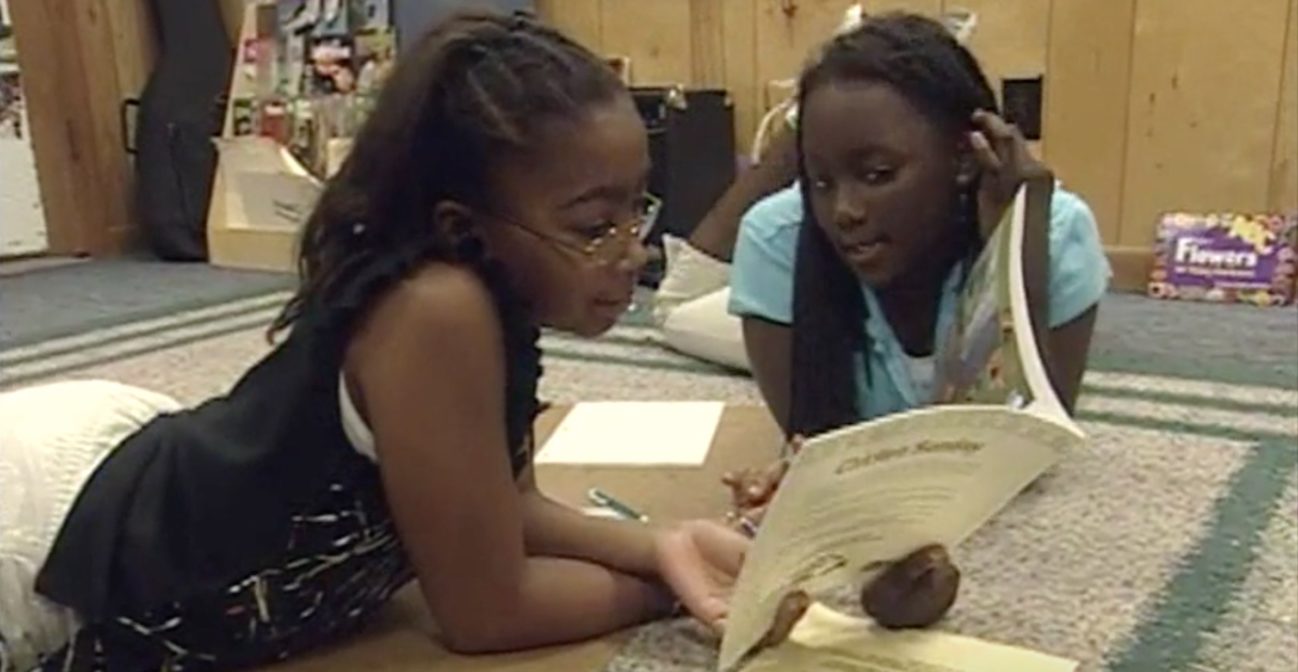
The Center for English Learning and Achievement (CELA) has made these two great resources available for teachers. Authored by Dr. Judith Langer and Elizabeth Close, both documents contain concise explanations of envisionment and concrete suggestions for creating a classroom where students have rich interactions with literature.
- Improving Literary Understanding Through Classroom Conversation
- Effective Literature Instruction Develops Thinking Skills
A Response-Based Approach to Reading Literature
 Judith A. Langer
National Research Center on Literature Teaching and Learning
University at Albany
State University of New York
1400 Washington Avenue, Albany, NY 12222
Report Series 6.7 1994
Language Arts, v71 n3, March 1994. Copyright 1994 by the National Council of Teachers of English Reprinted with permission.
Also published in Language Arts, Vol. 71, March 1994.
National Research Center on English Learning & Achievement
University at Albany, School of Education, B-9
1400 Washington Avenue, Albany, NY 12222
http://cela.albany.edu/
518-442-5026
The Center on English Learning & Achievement (CELA) is a national research and development center located at the University at Albany, State University of New York, in collaboration with the University of Wisconsin-Madison. The Center, established in 1987, initially focused on the teaching and learning of literature. In March 1996, the Center expanded its focus to include the teaching and learning of English, both as a subject in its own right and as it is learned in other content areas. CELA’s work is sponsored by the Office of Educational Research and Improvement (OERI), U.S. Department of Education, as part of the National Institute on Student Achievement, Curriculum, and Assessment.
“A Response-Based Approach to Reading Literature” is based on research conducted at the National Research Center on Literature Teaching and Learning, supported under the Research and Development Centers Program (Grant number R117G10015). Distribution is supported in part under award number R305A960005 as administered by OERI. However, the contents do not necessarily represent the positions or policies of the Department of Education, OERI, or the Institute on Student Achievement. All Center reports are peer reviewed before publication.
Published 1997
http://cela.albany.edu/response/index.html
Part 1
In this Research Report, I will discuss my work on response-based instruction, the strategies teachers call upon to orchestrate such classroom experiences, and ways in which it supports the development of students’ thinking. This work is part of a larger program of research into the teaching and learning of literature I began some years ago. During the past few years, an increasing number of researchers and theorists have been focusing on related issues relevant to language arts readers about the processes involved in understanding literature from a reader-based perspective (e.g., Benton, 1992, Corcoran, 1992, Eeds & Wells, 1989, Encisco, 1992, Rosenblatt, 1993), as well as ways to support students’ learning in the elementary and middle grades (e.g., Andrasik 1990, Cianciolo & Quirk 1992; Close 1990, 1992; Goodman & Wilde 1992; Many & Wiseman 1992; McMahon 1992; Nystrand, Gamoran, & Heck 1993; Zancanella 1992, Zarillo & Cox 1992). Still others have been focusing on literature-based and whole language instruction at the primary level (e.g., Jipson & Paley 1992; Mills, O’Keefe, & Stephens 1992; Morrow 1992; Roser in press; Uhry & Shephard 1993; Villaume & Worden 1993; Walmsley & Adams 1993; Yatvin 1992).
On the heels of the reform we have all witnessed in writing education has followed a widespread rethinking of literature in the English language arts, initiated as often as not by teachers who have wanted to bring their literature instructional practices in line with their student-focused approaches to writing. During this time, I have become increasingly aware that as teachers experiment with the many related types of response-centered approaches (including whole language and literature-based instruction), many are uncertain about the place of instruction in these paradigms and their role in it. On the one hand they are attracted to the notions underlying a pedagogy of student thoughtfulness because they think it provides students with ownership for their own learning, motivates and engages them in making sense, and provides a context for them to try out, negotiate, and refine their ideas in interaction with others. On the other hand, they are uncertain how to carry through such lessons.
Often I am asked, “Does anything go, and if not, how do I know what to do? Once I get an initial response, what do I do with it?” I consider these concerns valid, even predictable. The old teaching routines almost all of us learned in graduate coursework and saw modeled in curriculum guides, instructional materials, and assessment instruments don’t apply when response-based instruction is the goal. Yet the field has not yet provided adequate guidelines or strategies to allow teachers to build “new bones,” internalized routines and options to take the place of plot summaries and leading questions guiding students toward predetermined interpretations – new bones that can guide their moment-to-moment decision-making as they plan for and interact with their students.
For the past few years, through my work at the National Research Center on Literature Teaching and Learning (funded by the U.S. Department of Education, Office of Educational Research and Improvement), I have been working toward a reader-based theory for the teaching of literature – one that can help us understand what it means to make sense of literature from a reader’s point of view, and what that means for refocusing our instructional goals and practices (see Langer, 1990a, b; 1991, 1992a, b; 1993; Roberts & Langer 1991). One part of this work helps explain the process of literary understanding while the other addresses ways in which such understanding can be most effectively taught. I will discuss each in turn.
Part 2
The Process of Literary Understanding
My work suggests that for pedagogical purposes it is unproductive to conceptualize the teaching and learning of reasoning in general terms. In fact, there are basic distinctions in the ways readers (and writers) orient themselves toward making sense when engaging in the activity for literary or discursive purposes. In both cases readers have a sense of the local meaning they are considering at the moment, and also an overall sense of the whole meaning they are reading, writing, or thinking about; but they orient themselves differently to the ideas they are creating because their expectations about the kinds of meaning they will gain or create are different.
Horizon of Possibilities
A literary orientation involves “living through the experience.” It can be characterized as exploring a horizon of possibilities. It explores emotions, relationships, motives and reactions, calling on all we know about what it is to be human. For example, once we read and think we understand that Romeo and Juliet really love each other, we may begin to question how their parents would really feel about their relationship if they took the time to understand its depth, and this begins to reshape our understanding of the entire play. And then as we read on, we might begin to question whether Romeo and Juliet are bigger-than-life tragic figures, with their destiny somehow controlled by forces beyond even their parents’ control – more so when we try to make sense of Juliet’s decision to die. How, we ponder, could someone have prevented this from occurring?
Even when we finish reading we rethink our interpretations – perhaps at one time taking a psychological and at other times a political and at still other times a mythic stance toward the characters’ feelings and actions. Thus, throughout the reading (and even after we have closed the book) our ideas constantly shift and swell. Possibilities arise and multiple interpretations come to mind, expanding the complexity of our understandings.
In a literary experience, reading proceeds at two levels; on the one hand people consider new ideas in terms of their sense of the whole, but they also use their new ideas to reconsider the whole as well. There is an ever-emerging “horizon of possibilities” that enriches the reader’s understanding. Readers clarify ideas as they read and relate them to the growing whole; the whole informs the parts as well as the parts building toward the whole. In a literary experience, readers also continually try to go beyond the information. From the moment they begin reading, they orient themselves toward exploring possibilities – about the characters, situations, settings, and actions – and the ways in which they interrelate. Readers also think beyond the particular situation, using their text understandings to reflect on their own lives, on the lives of others, or on human situations and conditions in general. In doing this, they expand their breadth of understanding, leaving room for alternative interpretations, changing points of view, complex characterizations, and unresolved questions – questions that underlie the ambiguity inherent in the interpretation of literature.
Thus a literary orientation is one of exploring horizons – where uncertainty is a normal part of response and new-found understandings provoke still other possibilities. It involves a great deal of critical thought, but it is different from the kinds of thinking students engage in for their other academic coursework, where the focus is primarily on the acquisition of particular information (whether that information is cast as memorization of low-level “facts” or the understanding of complex theories and arguments).
Part 3
Point of Reference
When the purpose of reading is primarily for discursive purposes – to share or gain information (as when students read science and social studies texts), the reader’s orientation can be characterized as “maintaining a point of reference.” In this orientation toward meaning, from early on, readers (and writers) attempt to establish a sense of the topic or point being made (or to be made in their own writing). Once established, this sense of the whole becomes a relatively steady reference point. Unlike the frequent reconsiderations of the possibilities done during a literary reading, in this case, students attempt to build upon, clarify, or modify their momentary understandings – but rarely change their overall sense of the topic. Their sense of the whole changes only when a substantial amount of countervailing evidence leads them to rethink how what they are reading or writing “holds together.”
There is thus an essential difference between the two orientations toward meaning, a difference that can have a substantive effect on our understanding of critical thinking in education. While questions are raised in both literary and discursive approaches to understanding, it is the ways in which the questions are asked – where they emanate from and how they are treated – that mark the essential distinctions.
The exploration of horizons of possibilities lies at the heart of a literary experience. Here, use of the word “horizon” is critical, referring to the fact that horizons never lead to endings but continually advance; whenever a person (reader) takes a step towards the horizon (moving toward closure), the horizon itself shifts (and other possibilities are revealed for the reader to explore). Continually raising questions about the implications and undersides of what one understands (and using those musings to reconstrue where the piece might go) precludes closure and invites ambiguity. It can be argued that questions are at the heart of discursive thinking as well, and this is certainly the case. However, the reasons why those questions are asked differ, thus affecting the individual’s cognitive orientation. For example, scientific researchers usually consider their studies to be best if their initial questions lead to other questions – research is as much to generate questions as to uncover answers. However, the underlying purpose of the researcher’s questions is to narrow the gap between what is known and what is not about a field of inquiry, to move toward some form of closure, although true closure rarely occurs; it generally is yet another question that will help move thinking along. Thus, although “full” knowledge may never be reached, and successive questions may sometimes seem to muddy rather than elucidate what is known by pointing toward more complexities, the far off goal is the explication of knowledge. Here is the essential difference from a literary orientation where the musing itself is the goal.
Although I have been discussing the two orientations toward meaning in extreme terms, as if they were dichotomous, in actuality neither orientation operates alone, completely independent of the other. Instead, as suggested earlier, together they provide alternative ways of sense-making that can be called upon when needed. Although both purposes, literary and discursive, generally interplay in a variety of ways during any one experience, each situation seems to have a primary purpose, with the others being secondary. For example, when writing a paper providing important historical details on the Gulf war (involving a discursive orientation), a student might momentarily slip into a literary orientation – get caught up in describing the day-to-day life experiences of a member of an oil clean-up crew or of a woman soldier who had to leave her newborn when called up from the reserves – although most of the paper presents details and commentary on the war itself. Conversely, when writing from a literary orientation about a soldier or clean-up crew member (by portraying the personal lived-through experiences of the people, their relationships – their joys and tragedies) the student may at times “step out” of the living text she or he is creating and momentarily assume a discursive orientation in order to provide specific and accurate information about the details of the bombings, or the world’s reaction to Saddam’s dumping oil into the Gulf. In each case, it is the primary purpose that shapes the student’s overall orientation to the shape of the piece, but it is the interplay of the two that can add richness to the understanding that results.
However, research indicates that literature is usually taught and tested in a nonliterary manner, as if there is one right answer arrived at through point-of-reference reading or writing. Arthur Applebee’s Literature Center study of English classes across the United States (1993) indicates that literature is often taught as if there is a point or predetermined interpretation the reader must build toward, or as a literal reworking of the plot line from start to finish – with no room for the students’ explorations to be sanctioned or to take form.
Similarly, in history classes, even where the goal is to introduce literature into the curriculum, literary narratives are often used exclusively to mine information. For example, students are rarely given the opportunity to “live through” the polar expeditions of the arctic explorer or to “feel” the living conditions described by Isabel Allende, William Faulkner, Athol Fugard, Barbara Kingsolver, Zora Neale Hurston, Nadine Gordimer, Betty Bao Lord, Gabriel Garcia Marquez, or Alice Walker, and therefore to explore the possibilities involved in the worlds they create.
The same too often also holds true in “literature-based” primary grade classes (Walmsley & Walp 1989) where trade book stories are basalized, with detail questions retracing the story line instead of using students’ shared questions and developing interpretations as the primary focus of the lesson.
Alan Purves’ studies at the Literature Center (e.g., Brody, DeMilo, & Purves, 1989) indicate that literature tests (in anthologies, statewide assessments, SAT’s, and achievement tests of all sorts) treat literature as content, with a factual right answer rather than with possibilities to ponder and interpretations to develop and question and defend. His favorite multiple choice literature question, typical of those in many large-scale assessment tests, is: “Huck Finn is a good boy. True or False.” Such items call for superficial readings rather than thoughtful interpretations, or the weighing of alternative views.
Part 4
What does this mean for literature instruction?
For the past six years I have also been studying the new kinds of knowledge and strategies teachers rely on as their focus shifts from a primary concern with text-content and received interpretations to ways in which their students contemplate, extend, reflect on, and defend and hone their own growing understandings. However, even teachers who wish to support such thinking in their classrooms are often guided by their more long-lived notions of teaching and learning as they work with their students on a day-to-day basis.
For example, at an earlier phase in the project work, we reported that the teachers had made it quite clear that learning to listen to their students’ attempts at sense-making and to base instruction on their students’ responses is a difficult shift for them to make – even though they wish to do so. All of the project teachers were highly experienced, each with more than 10 years of teaching behind them. Yet the reliance on lesson plans that had been a mainstay of their training (and remains one way in which performance is reviewed by their supervisors) often worked counter to their student-based goals. They felt lesson plans required them to become text-based, determining the scope and sequence of activities and ideas within a particular lesson or unit in advance. Thus, when their students responded in ways they didn’t expect, the teachers felt torn – as if departing from the plan involved digressing rather than engaging in good instruction. It was for this reason, as well as the teachers’ more general requests for a bank of teaching “options,” that we studied the kinds of instructional strategies used during thoughtful lessons – to provide frames of reference (and eventually models) for teachers who wish to internalize a more comprehensive conception of ways to help their students develop as literary thinkers.
Over time, ten Research Assistants from the Center (who are all experienced teachers), more than forty teachers from a diverse group of suburban and city schools, and I have been working collaboratively to find ways to help students engage in the kinds of reasoning that literature can provoke – to arrive at their own responses, explore possibilities, and move beyond initial understandings toward more thoughtful interpretations. We have also been studying the classrooms carefully, analyzing the lessons that work, noting how the classrooms change over time, and coming to understand what underlies the contexts where rich thinking occurs (see Close, 1990, 1992; Langer, 1991, 1992a, 1992b; Roberts & Langer, 1991).
In addition, we have been studying the instructional strategies teachers implicitly (and sometimes explicitly) use to plan, develop, and carry through their lessons, and to move from one lesson to another. The findings were developed through macro- and micro-analyses of the following data sets: audiotapes and fieldnotes of discussions held during weekly full-project team meetings, including the teachers’ discussions of their lessons; fieldnotes of collaborative planning and post-lesson reflection sessions between teacher and research assistant; fieldnotes and audiotapes of class lessons; fieldnotes and interviews with collaborating students; and relevant artifacts from the lessons. From these, we derived a set of patterns that underlay the teachers’ decision-making. After these patterns had been searched and researched, they were presented to the teachers to reflect on, critique, and use. Then they were reworked and refined through a recursive pattern of teaching, observation and analyses of the lessons, and reflections on how they worked in practice, from the teachers’ and students’ as well as observers’ perspectives. Each time the patterns were revised, the teachers provided additional feedback, leading to the development of a two-part outline the teachers felt could be shared with others to provide visions for change as well as options for planning and teaching.
During last year, the project team continued to refine descriptions of the strategies by “testing” them against past lessons and teacher feedback. Each teacher (grades 1-12) developed a complete “demonstration” unit that was carefully studied. Audiotapes and fieldnotes (as well as instructional artifacts including all student writing and other work) were collected for every aspect of the entire unit. Then, the teachers’ understandings of the strategies were used to underlay informal interactions and more formal presentations to their colleagues and student-teachers about the ways in which they supported students’ thoughtfulness. Reflective interviews with research assistants and full-project discussions focused on the communicability of the strategies and the role they played in helping the teachers convey the ways in which they supported students’ involvement and thought, leading to the outlines that follow.
The first section briefly describes the overall goal of response-based instruction from this project’s perspective as well as some general guidelines that underlie the ongoing ethos and interaction of the classrooms. As presented in this first section, the earlier principles (see Langer, 1991) have been incorporated into a framework of strategies that captures the teachers’ instructional focus. These are the strategies they relied on to plan their lessons, make decisions about instructional support, and mark student progress. The strategies are presented in a way teachers felt could be shared with others as the basis for professional discussions about planning and decision-making during the course of ongoing lessons.
Part 5
Supporting the Literary Experience: The Focus of Instruction
The thought-provoking literature class is an environment where students are encouraged to negotiate their own meanings by exploring possibilities, consider understandings from multiple perspectives, sharpen their own interpretations, and learn about features of literary style and analysis through the insights of their own responses. Responses are based as much on readers’ own personal and cultural experiences as on the particular text and its author.
Some General Guidelines for Instruction
1. Use class meetings as a time for students to explore possibilities and develop understandings as opposed to recounting already acquired meanings (what they remember) and teaching what they’ve left out.
2. Keep students’ understandings at the center of focus – in writing as well as discussion. Always begin with their initial impressions. This will validate their own attempts to understand, and is the most productive place for them to begin to build and refine meaning.
3. Instruction, the help that moves beyond students’ initial impressions, involves scaffolding their ideas, guiding them in ways to hear each other – to discuss and think. Teachers need to be listeners, responders, and helpers rather than information-givers.
4. Encourage wonderings and hunches even more so than absolutes. They are part of the process of understanding literature. Whenever possible, ask questions that tap students’ knowledge. Pick up on what they say rather than following your own agenda or the sequence of the piece you are reading.
5. Encourage students to develop their own well-formed interpretations and gain vision from others’. There is more than one way to interpret any piece of literature.
6. Remember that questioning, probing, and leaving room for future possible interpretations is at the heart of critical thinking in literature. Teachers as well as students need to be open to possible meanings; in literary experiences there are no preconceived ends or final inviolable interpretations.
7. Help students learn by providing scaffolds that guide in ways to listen and speak to one another and in ways to think about their own developing understandings.
- Help students engage in more mature literary discussions by eliciting their own responses; asking for clarification; inviting participation; and guiding them in sustaining the discussion.
- Help students think in more mature ways by guiding them to focus their concerns; shape the points they wish to make; link their ideas with what they have already discussed, read, or experienced; and to think about their issues in more complex ways.
In addition, the project team developed an outline of options the teachers had internalized to replace their older options of plot summary, review of particular interpretations, and questions at different “levels” of comprehension. These new options guided them in ways to move the lesson along in support of students’ developing ideas. It must be pointed out that this is a framework of optional strategies teachers used; it is neither meant to indicate a linear process nor an inclusive one; each strategy was not taught during every lesson. The teachers had a grand view of the literature lesson, treating interactions before and after the actual reading and discussion as essential parts of the lesson. Thus, the shape of the literature lesson these teachers internalized had two main parts: beginning the literary experience (meaning all interactions that occur before the students read the text, see the movie, watch the play), and continuing (meaning all interactions that involve interaction with the literary text or event, as well as all the personal and public interactions and activities and meaning negotiations, including those that occur long after the “lesson” has ended, but thinking continues). The following framework is intended to stimulate discussion about options, with full awareness that these are the major ones this group of teachers relied on more extensively than others. Thus they serve as an open set of options, to be added to from this perspective.
Overall, teachers conceived of the lesson (extending across one or many days) as including three major sections (or options): inviting initial understandings, developing interpretations, and taking a critical stance. These replaced traditional lesson segments such as vocabulary review or plot summary, providing overall structural options to include or overlook (knowingly) in any given lesson. Some options for moment-to-moment interactions are briefly suggested beneath each section.
Part 6
FRAMEWORK OF OPTIONAL TEACHING STRATEGIES
BEGINNING THE LITERARY EXPERIENCE
EASING ACCESS BEFORE READING
Create a context for the literary experience:
- evoke broad personal, historical, cultural, or conceptual connections
- invite the literary experience (stepping into the text and exploring possibilities) as opposed to seeking information
CONCEPTUALIZING THE “ASSIGNMENT”
Provide students with opportunities to engage in varied activities with thought-provoking literature:
- experiences might involve creating, performing, or observing books, movies, plays, poems, or dramatic interludes accomplished jointly or alone, for themselves or for other.
CONTINUING THE LITERARY EXPERIENCE
INVITING INITIAL UNDERSTANDINGS
Keep students’ thoughts at the center of concern:
- tap students’ present envisionments – what is presently on their minds about the piece
- encourage wondering and hunches as well as more fully formed understandings
- do not use this time for evaluation, but for sharing initial understandings and beginning to explore beyond
DEVELOPING INTERPRETATIONS
Help students examine and extend their envisionments by questioning and building upon their current understandings. Focus on students’ comments to help them:
- explore and extend envisionments and seek possible explanations
- reflect on changes across time
- consider multiple perspectives from within the text and their own experiences
- use conflicting views within the discussion as an opportunity to explore rather than curtail thinking
TAKING A CRITICAL STANCE
Help students refine and sharpen their interpretations by objectifying and analyzing their understandings, the text, and their experiences:
- examine related issues from text, literature, and life
- build texture by examining alternative perspectives
- use others’ perspectives and related possibilities to challenge and enrich own responses
- analyze, explain, and defend own interpretations in light of text, other readings and experience
- consider received interpretations in light of own and others’ responses
- generalize to life by theorizing about the human condition; consider moral, message, and/or theme
- explore textual features and literary concepts from perspective of their own responses.
STOCKTAKING
Mark end of meeting without shutting off thinking:
- close session by summarizing key issues, noting changes in ideas, and pointing to concerns not adequately addressed as yet
- leave room for further exploration of possibilities
- invite continuing envisionment-building
We have found that these strategies support the principles of instruction and scaffolding described in previous work (e.g., Langer 1992, Roberts & Langer 1991). The teachers use them as lessons evolve, providing options to help them decide what to do next in response to students’ immediate needs as well as what to do as students’ understandings develop.
Also, we have come to see differences between these strategies and the more traditional approaches the teachers had formerly used. While more traditional instruction encourages teachers to base educational decision-making on learning experiences and tests that focus on “fixed” understandings that students acquired in their past (what the students “understood” or didn’t when they read the work, completed the assignments, or took the test), here, the teachers focus on the students’ developing understandings. The more thought-provoking lessons motivated by this framework of instructional strategies take place when teachers look for, listen to, and take their teaching cues from students’ “meanings-in-motion” – as students’ understandings are in the process of being formulated. This, we feel, needs to become an essential element in the new pedagogy.
This framework of instructional strategies is part of the development of a practical, response-based pedagogy to replace the more traditional positivist theories that presently underlie literature education. I hope that these ideas, combined with the other studies in this project and the related work of other researchers, will help provide the kind of specificity teachers need to internalize their own approaches to response-based instruction.
In general, then, when these options underlie teachers’ decision-making in the instructional environment, students are supported to explore, rethink, explain, and defend their own understandings. They begin with their own initial impressions, and use writing and discussion as well as further reading to ponder and refine their developing interpretations. The social structure of the class calls for (and expects) the thoughtful participation of all students. The teacher assumes that there will be multiple interpretations to be discussed and argued, and the students learn that pondering and defending horizons of possibilities that “counts” as evidence for literary thinking and knowing.
Part 7
Toward Meaningful Reform
In the collaborating classrooms from which these guidelines and strategies were derived, students are given room to work through their ideas in a variety of contexts (whole-class discussion, alone, small groups) and in a variety of activities (reading, writing, and speaking). Developing envisionments, exploring them, talking about them, and refining understandings underlay the very fabric of how the class works.
Although codified interpretations and particular points of view are discussed and considered, they are usually introduced and analyzed only after the students have had an opportunity to explore their own interpretations. Such analysis involves confronting, reexploring and possibly interweaving, refining, or changing their own interpretations. Thus, students are able to react to others’ ideas (including established interpretations) through the lens of their own considered understandings as well as the understandings of others – reaching interpretations that continue to be treated conditionally, always subject to further development.
In instructional contexts of this sort, that treat all students as thinkers and provide them with the environment as well as the help to do this, even the most “at-risk” students can engage in thoughtful discussions about literature, develop rich and deep understandings, and enjoy it too.
Appendix
References
Andrasick, K. D. (1990). Opening Texts: Using Writing to Teach Literature. Portsmouth, NH: Heinemann.
Applebee, A. N. (1993). Literature in the Secondary School: Studies of Curriculum and Instruction in the United States. Urbana, IL: National Council of Teachers of English.
Benton, M. (1992). Possible worlds and narrative voices. In J. Many & C. Cox (Eds.), Reader Stance and Literary Understanding (pp. 23?48). Norwood, NJ: Ablex.
Brody, P., DeMilo, C., & Purves, A. C. (1989). The Current State of Assessment in Literature (Report Series No. 3.1). Albany, NY: Center for the Learning and Teaching of Literature.
Cianciolo, P. J., & Quirk, B. (1992). Critical Analysis of a Distinctive Literature Curriculum (Report No. 55). East Lansing, MI: Center for the Learning and Teaching of Elementary Subjects, Michigan State University.
Close, E. (1990). How did we get here? Seventh graders’ sharing literature. Language Arts, 67(8), 817-823.
Close, E. (1992). Literature Discussion: A Classroom Environment for Thinking and Sharing. English Journal, 81(5), 65-71.
Corcoran, B. (1992). Reader Stance: From Willed Aesthetic to Discursive Construction. In J. Many & C. Cox (Eds.), Reader Stance and Literary Understanding (pp. 49-71). Norwood, NJ: Ablex.
Eeds, M., & Wells, D. (1989). Grand Conversations: An Exploration of Meaning Construction in Literature Study Groups. Research in the Teaching of English, 23, 4-29.
Enciso, P. (1992). Creating the Story World: A Case Study of a Young Reader’s Engagement Strategies and Stances. In J. Many & C. Cox (Eds.), Reader Stance and Literary Understanding(pp. 75-102). Norwood, NJ: Ablex.
Goodman, Y. & Wilde, S. (1992). Literacy Events in a Community of Young Writers. New York: Teachers College Press.
Jipson, J. A., & Paley, N. (1992). Is There a Base to Today’s Literature-Based Reading Programs? English Education, 24(2), 77-90.
Langer, J.A. (1990a). The Process of Understanding: Reading for Literary and Informative Purposes. Research in the Teaching of English, 24, 229-260.
Langer, J.A. (1990b). Understanding Literature. Language Arts, 67, 812-816.
Langer, J.A. (1991). Literary Understanding and Literature Instruction. (Report Series No. 2.11). Albany, NY: National Research Center on Literature Teaching and Learning.
Langer, J.A. (1992a). Literature Instruction: A Focus on Student Response. Urbana, IL: National Council of Teachers of English.
Langer, J.A. (1992b). Discussion as Exploration: Literature and the Horizon of Possibilities. In G. Newell & R. Durst (Eds.) Exploring texts: The role of discussion and writing in the teaching and learning of literature (pp. 23-44). Norwood, MA: Christopher Gordon.
Langer, J.A. (1993). Approaches Toward Meaning in Low- and High-Rated Readers. (Report Series No. 2.20). Albany, NY: National Research Center on Literature Teaching and Learning.
Many, J. E., & Wiseman, D. L. (1992). Analyzing Versus Experiencing: The Effects of Teaching Approaches on Students’ Responses. In J. Many & C. Cox (Eds.), Reader Stance and Literary Understanding (pp. 250-276). Norwood, NJ: Ablex.
McMahon, S. I. (1992). Book Club Discussions: A Case Study of Five Students Constructing Themes from Literary Texts (Report No. 72). East Lansing, MI: Center for the Learning and Teaching of Elementary Subjects.
Mills, H., O’Keefe, T., & Stephens, D. (1992). Looking Closely: Exploring the Role of Phonics in One Whole Language Classroom. Urbana, IL: National Council of Teachers of English.
Morrow, L. M. (1992). The Impact of a Literature-Based Program on Literary Achievement, Use of Literature, and Attitudes of Children from Minority Backgrounds. Reading Research Quarterly, 27, 250-275.
Nystrand, M., Gamoran, A., & Heck, M. J. (1993). Using Small Groups for Response to and Thinking About Literature. English Journal, 82(1), 14-22.
Roberts, D., & Langer, J. A. (1991). Supporting the Process of Literary Understanding: Analysis of a Classroom Discussion (Report Series No. 2.15). Albany, NY: National Research Center on Literature Teaching and Learning.
Roser, N. L. (in press). From Literature to Literacy: A New Direction for Young Learners. In J. Flood & J.A. Langer (Eds.), Literature Instruction: Practice and Policy. New York: Scholastic.
Rosenblatt, L. M. (1993). The Transactional Theory: Against Dualisms. College English, 55, 377-386. Uhry, J. K., & Shepherd, M. J. (1993). Segmentation/Spelling Instruction as Part of a First-Grade Reading Program: Effects on Several Measures of Reading. Reading Research Quarterly, 28, 218-233.
Villaume, S. K., & Worden, T. (1993). Developing Literate Voices: The Challenge of Whole Language, Language Arts, 70(6), 462-468.
Walmsley, S., & Walp, T. (1989). Teaching Literature in Elementary School (Report Series No. 1.3). Albany, NY: Center for the Learning and Teaching of Literature.
Walmsley, S. A., & Adams, E. L. (1993). Realities of ‘Whole Language.’ Language Arts, 70(4), 272-280.
Yatvin, J. (1992). Developing a Whole Language Program for a Whole School. Midlothian, VA: Virginia State Reading Association.
Zancanella, D. (1992). Literary Lives: A Biographical Perspective on the Teaching of Literature. In J. Many & C. Cox (Eds.), Reader Stance and Literary Understanding (pp. 217-234). Norwood, NJ: Ablex.
Zarillo, J., & Cox, C. (1992). Efferent and Aesthetic Teaching. In J. Many & C. Cox (Eds.), Reader Stance and Literary Understanding (pp. 235-249). Norwood, NJ: Ablex.
Acknowledgments
I would like to thank Carla Confer, Sr. Judith Dever, Ester Helmar-Salasoo, Elba Herrero, Irene Pompetti-Szul, Barbara Risalvato, Doralyn Roberts, Eija Rougle, Mary Sawyer and Francine Stayter as well as all the teachers and students who composed our research community and participated as fellow learners in this seven-year project.