
American Passages: A Literary Survey
Gothic Undercurrents Edgar Allan Poe (1809-1849)
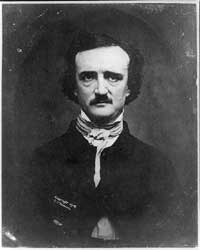
[7244] W. S. Hartshorn, Edgar Allan Poe (1848), courtesy of the Library of Congress [LC-USZ62-10610].
Poe was influenced by the fantastic romances of Charles Brockden Brown, Washington Irving, and Nathaniel Hawthorne. However, unlike most of his famous contemporaries, Poe rarely described American life in any direct way in his writings. Often set in exotic, vaguely medieval, or indeterminately distant locations, Poe’s work seems more interested in altered states of consciousness than history or culture: his characters often swirl within madness, dreams, or intoxication, and may or may not encounter the supernatural. His literary reputation has been uneven, with some critics finding his extravagant prose and wild situations off-putting or absurd (and his poetry pedestrian and repetitive). Poe’s defenders, however (including many nineteenth- and twentieth-century French intellectuals), see him as a brilliant allegorist of the convolutions of human consciousness. For example, there are many “doubles” in Poe: characters who mirror each other in profound but nonrealistic ways, suggesting not so much the subtleties of actual social relationships as the splits and fractures within a single psyche trying to relate to itself.
Teaching Tips
- Poe works very well for spatial analysis and analyses of setting– that is, for considering the importance of the stories’ spaces (e.g., houses, prisons) and the locations (e.g., “exotic” or medieval places and times). In preparation for class discussion, have students draw a picture of the setting of one of Poe’s stories and ask them to annotate it with what each aspect of the setting symbolizes.
- What is haunting Poe’s houses? Ask students to contextualize Poe’s use of the haunted house through comparing his use with Henry Ward Beecher’s “haunted house” in “The Strange Woman.”
- Students are often quick to pick up on the “unnatural relations” between Usher and his sister in “The Fall of the House of Usher,” but are unclear what to make of them. It can be helpful to point out that incest is a common theme in early national literature (Melville’s Pierre is another famous example). Why would early national writers in general, and Poe in particular, be interested in incest as a theme?
Author Questions
- Comprehension: Does “Ligeia” represent supernatural events? What difference does your answer make to our understanding of the story?
- Comprehension: How does the setting of “Ligeia” affect your understanding of the story?
- Context: In an essay about composing literature, Poe wrote the following: “the death, then, of a beautiful woman is, unquestionably, the most poetical topic in the world–and equally is it beyond doubt that the lips best suited for such topic are those of a bereaved lover.” What do you think he meant by this? How does “Ligeia” fit into this philosophy of literature? Consider how the narrator describes Ligeia, how he feels and what he thinks about her: what does the story suggest about the proper roles or characteristics of men and women? How is Ligeia like and unlike the ideal woman as conceived by adherents of the cult of true womanhood?
- Exploration: The narrator is unsure about many things in “Ligeia,” including when and where he met Ligeia, her last name, and whether he is mad. In fact, it is possible to say that the story is about uncertainty: “Not the more could I define that sentiment, or analyze, or even steadily view it,” says the narrator at one point. How does Poe explore the dilemma of ambiguity in “Ligeia”? What does he seem to be saying about the mind’s attempt to establish certainty?
Selected Archive Items
[3111] James William Carling, The Raven (c. 1882),
courtesy of the Edgar Allan Poe Museum, Richmond, Virginia.
This illustration, by James Carling for an 1882 edition of “The Raven,” reflects the dark and foreboding tone of Poe’s classic poem.

[7064] Cortlandt V. D. Hubbard, Poe’s Bedroom in Philadelphia (1967),
courtesy of the Library of Congress [HABS, PA,51-PHILA,663A-4].
This photograph shows Poe’s bedroom on the second floor of the building now known as the “Edgar Allan Poe House.” Poe wrote many of his most famous works during the six years he lived in Philadelphia.

[7244] W. S. Hartshorn, Edgar Allan Poe (1848),
courtesy of the Library of Congress [LC-USZ62-10610].
Poe developed the detective story genre but was also known for his poetry, critical essays, and sketches.

[8643] Emory Elliott, Interview: “Mid-Nineteenth- Century America” (2001),
courtesy of Annenberg Media.
Emory Elliott, professor of English at the Unversity of California, Riverside, discusses the climate of fear which characterized much of mid-nineteenth-century American life and culture.
[8648] Emory Elliott, Interview: “The American Gothic” (2001),
courtesy of Annenberg Media.
Emory Elliott, professor of English at the University of California, Riverside, discusses the influence of the occult on nineteenth-century American writers.